Before the Recipe Card: How Cooking Instructions Were Kept
Learn how cooking instructions moved from memory and shared practice to written recipes, and what to record so a family method can travel clearly.
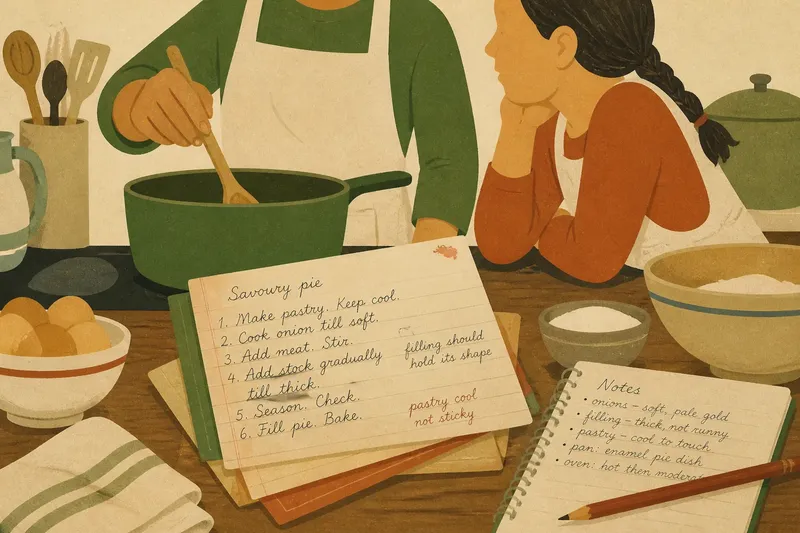
A cook stirs a pot while a child watches, then says, “Keep going until it looks right.” That instruction may work beside the stove, but it is harder to use later in another kitchen. Before the recipe card, many cooking methods travelled through memory, demonstration and repeated practice. Writing them down changed how a cook could preserve and share those methods.
Memory kept a method close to the cook
In households where cooking was taught through daily work, a learner could watch someone handle dough, judge a simmer or recognise when a pot was ready. The experienced cook supplied cues that a short list of ingredients could not carry. This was one way of passing on knowledge, rather than a single pattern that applied everywhere.
Such instruction could bend to circumstances. “Add flour until it holds together” leaves room for differences in the grain, the mixture and the cook’s judgement. But the method depended on being able to watch, ask questions and remember the sequence.
Memory did not mean that cooks lacked routines. Familiar bowls, habitual portions and repeated actions could help a household prepare a dish without formal measurements. In those kitchens, part of the recipe was held in ordinary practice.
Shared cooking carried details that words miss
Cooking beside someone passes on more than a sequence. A teacher can point to the colour of softened onions, show how firmly to knead or move a pan away from the hottest part of a fire. These corrections arrive at the moment they matter. A written note, by contrast, has to anticipate what its reader may not know.
Oral instruction may use comparisons: cook until the mixture resembles cream, or stop when the dough feels like an earlobe. Such phrases can be vivid, but their meaning may shift between cooks, ingredients and surroundings.
Say a learner is making a family’s savoury pie with an aunt. The aunt shows when the filling has thickened enough to stay in place and explains that the pastry should feel cool rather than sticky. Later, the learner writes down the order of mixing and the oven setting, while keeping those texture cues beside the steps. The note carries the sequence; the demonstration helps make its words understandable.
Written recipes made methods portable
Writing lets instructions outlast a particular lesson. A note can be passed to someone who was not present, kept for another occasion or carried into a different kitchen. It also makes comparison easier: two versions can sit side by side, showing, for instance, that one adds liquid before flour while another reserves it.
Older written cooking directions were not necessarily the tidy, self-contained recipes familiar from many cookbooks today. Some notes assumed that readers already knew how to prepare an ingredient or manage a fire. Others were reminders, not complete teaching tools. The reader still supplied knowledge from experience.
Writing also gives a method visible boundaries. An ingredient list shows what the writer considers part of the dish; numbered actions can mark what comes first and what follows. Yet a record can leave out the adjustments that helped the original cook make the meal work.
Measurements and sequence shaped what could be repeated
Quantities can help a reader who lacks the original cook’s eye, but a written measure is not automatically precise. A cup, spoon or handful can mean different things, and an ingredient’s condition affects how it behaves. A note is more useful when it names the measure and clarifies how the ingredient is prepared.
Sequence matters too. “Mix everything” offers less guidance than saying when to combine wet and dry ingredients or when to add seasoning. “Add gradually” records a choice the cook might otherwise make by judgement. For a method that depends on timing or texture, the writer must decide which observations another person needs.
If you are copying a recipe for someone else, record the cues that shaped your next action. Note whether a sauce should coat a spoon, whether a loaf should sound hollow when tapped, or whether to take the pan off the heat before adding an ingredient. A useful note connects each cue to what the cook should do next.
What does a written recipe preserve?
Why do some recipes leave out quantities?
A note may have been meant for a cook who already knew the usual proportions, or it may have served as a memory prompt rather than a full lesson. The writer might also have relied on judgement by feel instead of fixed measures.
Can a written recipe replace watching someone cook?
It can preserve ingredients and sequence, but gestures and sensory cues are harder to capture. Descriptions of colour and texture help, while a demonstration can show what those words mean in practice.
What should I add when copying a family recipe?
Keep the original wording where it carries useful character, then add clarifications about the order of actions, the appearance of key stages and familiar equipment. Mark your additions so readers can distinguish them from the older note.
Why do versions of the same dish differ?
Cooks adapt instructions to ingredients, tools, tastes and household routines. A written version preserves one account of a dish, not every variation that may have been used.
A recipe card records the kitchen, but cannot contain it
A handwritten card can hold a useful sequence and still depend on knowledge left off the page. A smudge beside “add milk” might mark a familiar adjustment; a margin note might name the pan the cook prefers. Treat these traces as clues. If a recipe matters to you, copy it clearly, retain its original wording where possible and add observations that would help someone unfamiliar with its habits.
Cooking instructions move through both words and people. Memory lets a method adapt, demonstration gives it texture, and writing carries it beyond the room where it was learned. When you save a recipe, include the cue that tells the next cook what to recognise and what to do. That small detail can make an old method easier to use in a new kitchen.